

We are a Bible believing Southern Baptist Church that holds to the Doctrines of Grace.
Mayflower Church is a Southern Baptist church at 207 Main Street in Kingston, Massachusetts. We hold the Baptist Faith and Message 2000 and teach from the 1689. If you are wondering what those words mean, our page on what a Reformed Baptist church is gives a plain answer.
We cooperate with other Southern Baptist churches through the Baptist Churches of New England (BCNE). We aim to know Christ and make Him known. Another way we say it is that we aim to Love God, Love Others, & Make Disciples. Our church was founded in 1828. Older listings and records may show us as Mayflower Congregational Church. We are the same church at the same address, and today we are Mayflower Church, a Southern Baptist church.
We are Baptist in our theology.
Baptist noun | ˈbap-tist. Baptists emphasize believer’s baptism by full immersion, upon personal profession of faith in Jesus Christ.
We are congregational in our church government.
Congregational adjective | kän-gri-ˈgā-shə-nəl. Congregationalists maintain that the gathered assembly of believers, guided by Scripture and the Holy Spirit, has the right and responsibility to govern itself in matters of doctrine, membership, discipline, and leadership.
We gather on Sundays at 10:00 a.m., in person and online, and we serve Kingston and the neighboring towns of Plymouth, Carver, Duxbury, Pembroke, Halifax, Plympton, Hanson, & beyond.
Our Five Core Values
At Mayflower, our five core values are not simply ideas on paper—they shape the very way we live as God’s people together. Each value flows from Scripture and leads us into a life that reflects Christ, both within the church and in the world.
Scripture
We believe the Bible is the inspired, inerrant, and sufficient Word of God, our final authority for faith and practice (2 Tim. 3:16–17). It is through Scripture that God reveals Himself, convicts of sin, and brings about salvation and sanctification. As a church, we are committed to expositional preaching and biblical teaching in all we do, submitting joyfully to God's Word.
Missions
We are called to make disciples of all nations (Matt. 28:18–20). Missions is not an optional activity but the outflow of gospel-centered, Christ-exalting obedience. We support missions that are rooted in the local church, prioritize church planting, and emphasize proclaiming the gospel clearly and faithfully across cultures for the glory of Christ and the salvation of the lost.
Discipleship
The Christian life is not merely a profession of faith but a lifelong pursuit of Christlikeness. Discipleship happens as we teach one another to obey all that Christ has commanded (Matt. 28:20). We are committed to intentional, relational discipleship through sound doctrine, mutual accountability, and Spirit-empowered growth, led by faithful elders and supported by the body.
Worship
True worship is God-centered, Scripture-regulated, and Christ-exalting (John 4:24). We gather each Lord’s Day to glorify God in reverence and joy through the ordinary means of grace—preaching, prayer, singing, giving, and the ordinances. Our worship is shaped by the gospel, with the Word of Christ dwelling richly among us.
Fellowship
Biblical fellowship is more than social interaction—it is a sharing in Christ and a mutual commitment to build one another up in faith and love (Acts 2:42; Heb. 10:24–25). We pursue a culture of hospitality, encouragement, and accountability as members of one body, bearing each other’s burdens and striving for unity in Christ.
We hold to the creeds of historic Christianity.
We hold to the faith summarized in the Apostles’ Creed, the Nicene Creed, and the Chalcedonian Creed. We receive these creeds because they faithfully summarize Scripture, which alone is our final authority, and in holding them, we stand with believers across the centuries.
The Apostles’ Creed
I believe in God the Father, Almighty, Maker of heaven and earth,
And in Jesus Christ, His only begotten Son, our Lord,
Who was conceived by the Holy Ghost, born of the Virgin Mary,
Suffered under Pontius Pilate; was crucified, dead and buried; He descended into hell,
The third day He rose again from the dead,
He ascended into heaven and sits at the right hand of God the Father Almighty,
From thence He shall come to judge the quick and the dead,
I believe in the Holy Ghost,
I believe in the holy catholic (universal) church; the communion of saints; the forgiveness of sins; the resurrection of the body; and the life everlasting.
Amen.
Philip Schaff, in his Creeds of Christendom, writes of the Apostles’ Creed, “As the Lord’s Prayer is the Prayer of prayers, the Decalogue is the Law of laws, so the Apostles’ Creed is the Creed of creeds. It contains all the fundamental articles of the Christian faith necessary to salvation, in the form of facts, in simple Scripture language, and in the most natural order—the order of revelation—from God and the creation down to the resurrection and life everlasting.” The simple doctrinal statements within this creed are clear and concise, and their meaning cannot be misconstrued.
The Nicene Creed
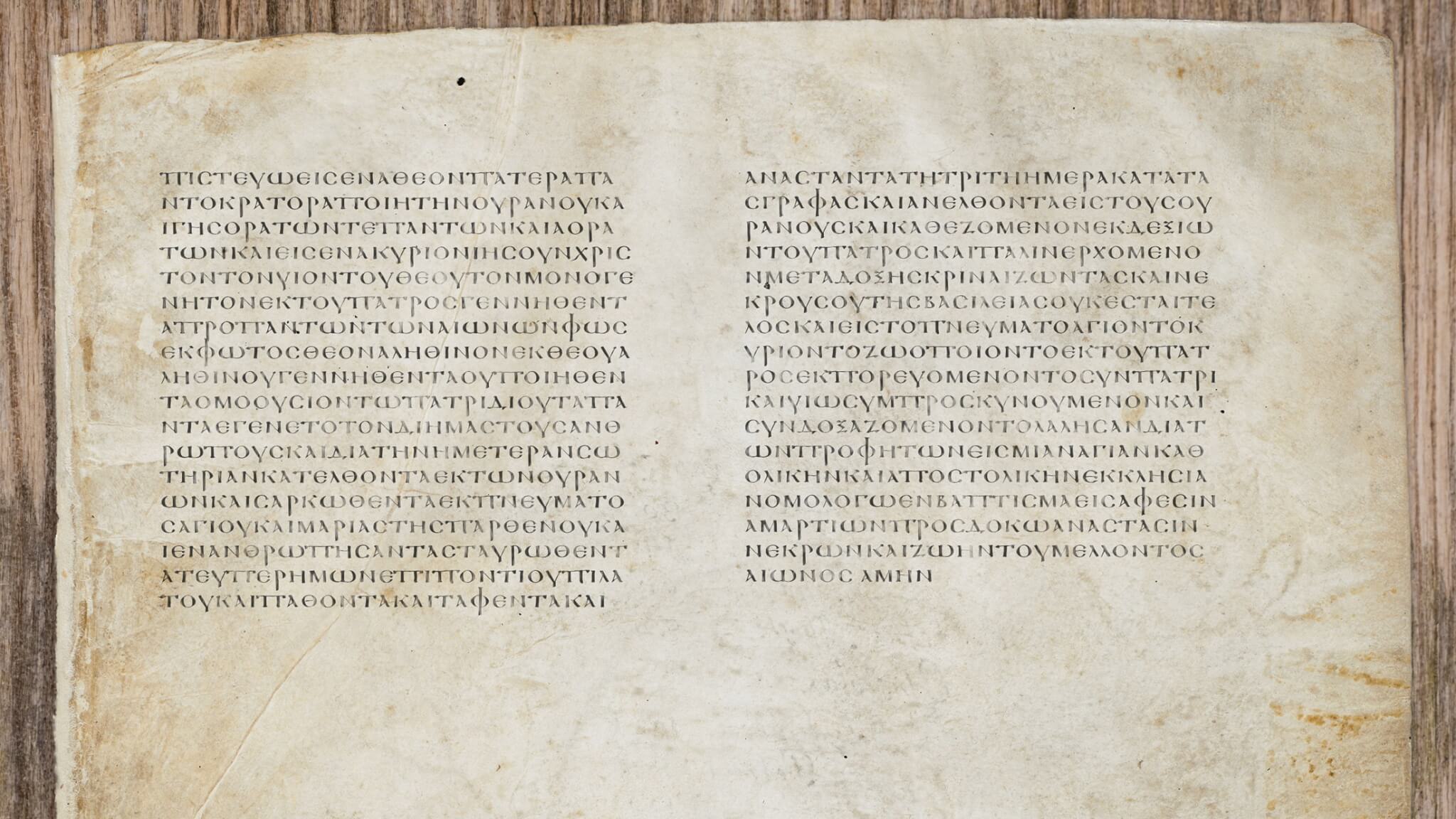
I believe in one God, the Father Almighty, Maker of heaven and earth, and of all things visible and invisible.
And in one Lord Jesus Christ, the only-begotten Son of God, begotten of the Father before all worlds; God of God, Light of Light, very God of very God; begotten, not made, being of one substance with the Father, by whom all things were made.
Who, for us men for our salvation, came down from heaven, and was incarnate by the Holy Spirit of the virgin Mary, and was made man; and was crucified also for us under Pontius Pilate; He suffered and was buried; and the third day He rose again, according to the Scriptures; and ascended into heaven, and sits on the right hand of the Father; and He shall come again, with glory, to judge the quick and the dead; whose kingdom shall have no end.
And I believe in the Holy Ghost, the Lord and Giver of Life; who proceeds from the Father and the Son; who with the Father and the Son together is worshipped and glorified; who spoke by the prophets.
And I believe in one holy catholic (universal) and apostolic Church. I acknowledge one baptism for the remission of sins; and I look for the resurrection of the dead, and the life of the world to come. Amen.
The Nicene Creed was originally the result of the Council of Nicea in A.D. 325. While there are similarities between the text of the Nicene Creed and the text of the Apostles’ Creed, the Nicene Creed, according to Schaff, is “more definite and explicit than the Apostles’ Creed in the statement of the divinity of Christ and the Holy Ghost.” The Nicene Creed provided the needed clarification to combat the heresies of the Nicene age and is useful to combat those same heresies today which invariably reoccur in differing forms.
The Symbol of Chalcedon
We, then, following the holy Fathers, all with one consent, teach men to confess one and the same Son, our Lord Jesus Christ, the same perfect in Godhead and also perfect in manhood; truly God and truly man, of a reasonable [rational] soul and body; consubstantial [coessential] with us according to the manhood; in all things like unto us, without sin; begotten before all ages of the Father according to the Godhead, and in these latter days, for us and for our salvation, born of the Virgin Mary, the mother of God, according to the Manhood; one and the same Christ, Son, Lord, Only-begotten, to be acknowledged in two natures, inconfusedly, unchangeably, indivisibly, inseparably; the distinction of natures being by no means taken away by the union, but rather the property of each nature being preserved, and concurring in one person and one Subsistence, not parted or divided into two persons, but one and the same Son, and only begotten, God the Word, the Lord Jesus Christ, as the prophets from the beginning [have declared] concerning Him, and the Lord Jesus Christ Himself has taught us, and the Creed of the holy Fathers has handed down to us.
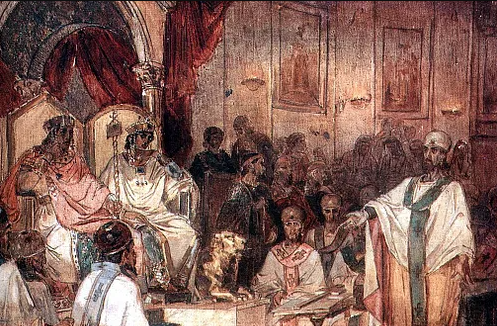
The Symbol of Chalcedon, adopted at the Fourth Ecumenical Council, dates back to A.D. 451. Philip Schaff, in his Creeds of Christendom, writes of the Symbol (or Creed) of Chalcedon, “While the first Council of Nicaea had established the eternal, pre-existent Godhead of Christ, the Symbol of the Fourth Ecumenical Council relates to the incarnate Logos, as he walked upon the earth and sits on the right hand of the Father. It is directed against the errors of Nestorius and Eutyches, who agreed with the Nicene Creed as opposed to Arianism, but put the Godhead of Christ in a false relation to his humanity.”

Copyright 2026 Mayflower Church
All Rights Reserved.